Quantum Dots, Quantum Mechanics & Displays

What Are Quantum Dots?
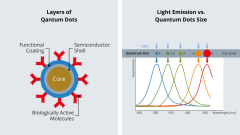
Quantum dots (QDs) are tiny crystals in the nano-meter range. They consist of a cluster of semiconductor atoms, often surrounded by an additional semiconductor layer. An outer functional polymer or lipid coating enables coupling with proteins, oligonucleotides (short DNA or RNA molecules), antibodies, or other molecules (Figure 1). Measuring between 2 and 10nm – roughly 10 to 150 atoms – they exhibit remark-able optical and electrical properties.
These characteristics can be tuned by adjusting particle size, material, and composition. These features make quantum dots interesting for a wide range of applications, including optical sensors, biomonitoring, drug delivery, solar cells, displays, and even photocatalysis (light-driven chemical reactions). In 2023, Alexei Ekimov, Louis Brus, and Moungi Bawendi were awarded the Nobel Prize in Chemistry for their three decades of pioneering research on quantum dots.
Quantum Physics
Since Austrian physicist Anton Zeilinger (together with Alain Aspect and John Clauser) received the Nobel Prize in Physics for his experiments with entangled photons, including the demonstration of quantum teleportation, the term »quantum« has become familiar to a wider audience. Quantum physics describes the behavior and interaction of the smallest particles on the atomic and subatomic range. Quantum mechanics, a subset of quantum physics, focuses on the properties of states and processes of matter. The term quantum has its origin in the Latin word quantum, meaning »how much« or »how large«. It describes something measurable, something »quantifiable«. Today in physics, quantum is associated with the particle-like nature of a given property.
Quantum Dots – Applications in Displays
What makes quantum dot technology so interesting for displays is photoluminescence. Quantum dots can absorb light and re-emit it at a different wavelength. The color of the emitted light depends directly on the particle size – the smaller the dot, the shorter the wavelength. This is due to the fact that very small particles, only a few nanometers in size, provide less space for electron oscillation, directly affecting optical properties. Using InP (indium phosphide) and ZnS (zinc sulfide) quantum dots, 6nm dots emit long-wave red light, 3nm dots emit green light, and 2nm dots emit short-wave blue light. Typically, a blue light source with a wavelength of 450nm is used.
Comparing TFT-LCD Technology with New Quantum Dot TFTs
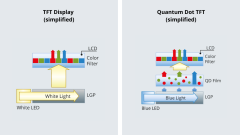
In general, a conventional TFT display uses a backlight. White LEDs produce light that passes through color filters, creating a colored image. White LEDs consist of a blue LED chip covered with YAG phosphor (yttrium aluminum garnet), which emits white light. The downside of this technology is that the resulting colors are not as pure and vivid. This is due to the wide emission spectrum, causing colors to interfere with each other.
In a quantum dot display, however, blue LEDs replace the white ones for the backlight. The QD layer is placed directly on the light-guide. When simulated by the blue LEDs, the quantum dots emit vibrant red and green light, which combines with the blue light to produce white light. As in a regular LCD, the final image is formed by passing
the light through a color filter.
Comparing OLED Displays with Quantum Dot OLED Displays
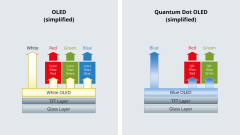
It’s important to note that »OLED« here always refers to an AMOLED display, which is a display with a TFT layer (active matrix) that controls the individual organic LEDs for each pixel. In standard OLED displays, white OLEDs are used for the pixels or subpixels. Like in TFT displays, color is generated using a color filter. The differ-ence from TFT-LCDs is that OLED displays also make use of the white light emitted by the OLEDs.
When integrating quantum dot technology, the QD layer and color filter are placed directly above the light source – in this case, the OLEDs. White OLEDs are replaced by blue ones, and the quantum dots emit red and green light when excited by the blue light, while the blue is used directly.
Advantages of Quantum Dot Displays
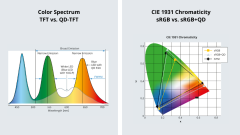
Wider Color Gamut: Integrating quantum dots expands a display’s color gamut, allowing it to render a broader range of colors. This enables manufacturers to reproduce colors that are closer to what we see in nature. For a better understanding, the color gamut refers to the full range of colors perceivable by the human eye. In the CIE color system, colors are represented mathematically, producing a tongue-shaped diagram showing saturation and hue (wavelength). One example is the sRGB (standard red-green-blue) color gamut, which defines the colors that can be displayed on a digital device (e.g., a monitor). Quantum dots can expand a display’s sRGB gamut by 35-45%.
Improved Color Accuracy: A major advantage is the significantly improved color reproduction. Quantum dots emit light at specific wavelengths and have a narrow full width at half maximum (FWHM) of about 20-35nm. Interference is minimized, resulting in purer colors and a more vibrant, lifelike visual experience.
Brightness and Energy Efficiency: Quantum dots also increase display brightness. Compared to a non-QD display, this can reduce power consumption while maintaining the same brightness. In LCDs, even better results are achieved by combining QD technology with a Micro-LED backlight. Such displays offer brilliant color, high contrast, and improved energy efficiency.
Highlights of Quantum Dot Technology
Displays using QD technology deliver outstanding color performance and a significantly wider color gamut than standard displays. This allows for rich, vivid colors that closely resemble those found in nature, offering viewers a more realistic visual experience. The main applications are in medical imaging and professional video production, where accurate color representation and a wide color range are crucial.
Your Contact Person
Your contact person regarding display solutions is Christian Forthuber.